
How D&D 5e Evolved from the 2014 Core to the 2025 Monster Manual

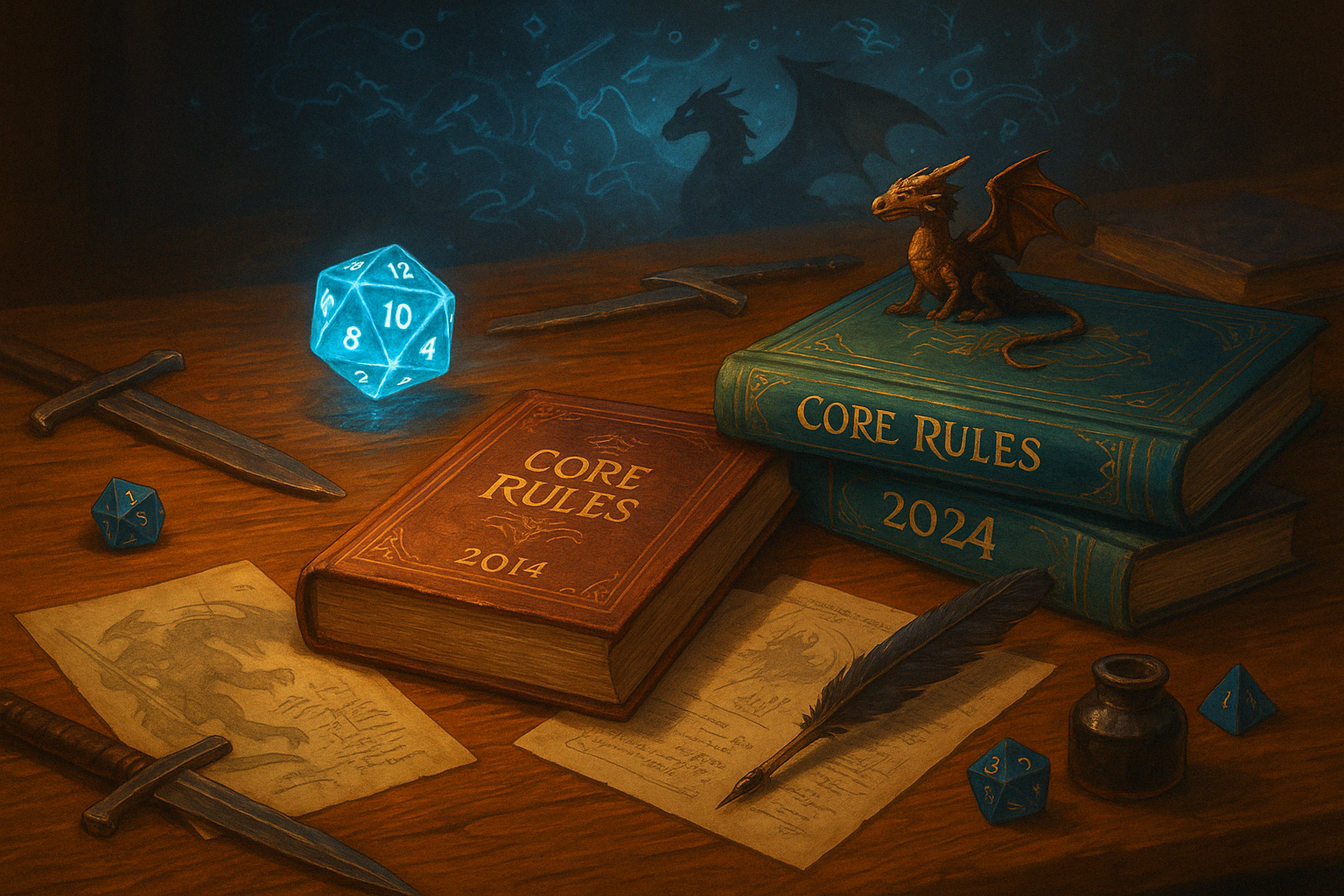
Engineering Simplicity & Expanding Possibility
(a problem‑first chronicle of design choices, threaded with narrative hooks, emotional beats, and tinkerer tools)
Act I – Compression (2011‑2014)
Design problem. By late 4e, players juggled a blizzard of +1/‑2 situational modifiers; new groups stalled on page‑flips.
Rule answer. Advantage/Disadvantage collapsed dozens of ad‑hoc numbers into one dramatic moment—roll twice, keep the best (or worst). Survey data from 175 K play‑testers flagged it as the single most satisfying rule in the packet. citeturn0file0
Running the Scene
The rogue knees an ogre, imposing disadvantage on its next swing. Two d20s thunder; the low die rules. Applause, no chart‑dives, and play surges forward.
Role‑play ripple. The dice hit before the Dungeon Master rules, granting micro‑beats of communal tension that teach pacing as surely as they resolve math.
Act II – Expansion (2024 Player’s Handbook)
Design problem. Martial classes delivered consistent damage but few decisions after level 5.
Rule answer. Weapon Mastery embeds a tactical rider—Cleave, Push, Sap, Vex, Slow, etc.—in every weapon. Fighters start with three mastered options, other martials with two; any class can grab the new feat. citeturn0search0
Running the Scene
Round 1: Paladin draws a morningstar (Sap), tagging the fiend with −1d4 on its next save.
Round 2: She swaps to a glaive (Push), flinging the fiend off the battlements. No new subsystem—just rider tags on the existing weapons table.
Narrative hook. Mastery riders telegraph story beats: a hobgoblin commander scythes villagers with Cleave before initiative, cementing menace instantly.
Character emotion. A battle‑scarred fighter rotates between a war pick (Topple) and a longbow (Slow), each swap mirroring hard‑won tactical insight—an arc that plays visibly at the table or on stream.
Hack It.
Old‑school night? Ignore rider tags to revert to 2014 feel.
Dark Sun reskin? Translate Push → Cripple (speed 0) and keep the DC math—bone weapons, zero prep.
Act III – On‑Ramp (2024 Dungeon Master’s Guide)
Early DMGs opened with planar essays; new Dungeon Masters need scenes first. The 2024 book flips the order:
| Chapter | Purpose |
|---|---|
| Session Zero | comfort tools, campaign pitch |
| Adventures | roll‑and‑go villain & locale tables |
| Campaigns | Greyhawk mini‑setting as annotated example |
| Bastions | downtime domain play |
| Appendix | full index that finally works on a phone PDF |
Polygon’s preview notes the layout “puts practical tools before cosmology—exactly where rookies look first.” citeturn1news3
Ten‑Minute Prep Demo
- Roll Villain Goal d12 → Steal a relic.
- Roll Town Quirk d8 → Worships water elementals.
- Drop the lair on Greyhawk’s Mistmarsh fold‑out map.
Game night saved; depth feels intentional.
Sandbox turbo.
Roll three fast complications:
d20 Complication | d12 Ally | d8 Twist
18 Explosive runes | 7 Street bard | 2 Ally’s sibling is secretly the villain's agent
Instant intrigue—heist in ninety seconds.
Act IV – Calibration (2025 Monster Manual)
Design problem. Challenge rating math under‑valued mobility and action compression; alphabetical index slowed improvisation.
Rule answer. The new MM introduces triple index (Alphabetic, Habitat, CR) and family stat suites—hobgoblin phalanx units share a Shields‑Up reaction, for example. GamesRadar highlights how action compression, save tax, and mobility now weigh heavily in CR calculations. citeturn4news10
Running the Scene
Need a CR 9 desert ambush? Flip to Habitat: Wastes, grab the Ankheg Brood‑Mother and Hobgoblin Artillerists—both keyed to “Burrow/Flank” family tactics. Combat feels storyboarded, not prefabbed.
Villain case study. Lygia, Curator of Blighted Tomes (CR 10) wields a Sap‑tagged Blight Quill and a family reaction Ink Cloud to half‑obscure the field—players grasp her theme and tactics at a glance.
Difficulty dial.
- Spike lethality: grant Lygia legendary resistance, remove her minions.
- Soften blow: swap Ink Cloud for once‑per‑round flourish.
Act V – Inclusivity & Data Feedback
The 2024 PHB drops “race” for species, detaching ability scores from lineage. Polygon stresses that backgrounds now carry the ASI and an origin feat, threading backstory into mechanics. citeturn0search3
Behind the curtain, millions of anonymized D&D Beyond characters revealed pain points: under‑played half‑orcs, monks fading mid‑tier, martial feat gaps. Ki now scales with Proficiency, half‑orcs morph into flexible orc traits, and Weapon Mastery slots into the feat economy—balance fixes born directly from data. citeturn0file0
Role‑play ripple. Players enter Session Zero pitching story, not negotiating stat penalties. A tiefling barbarian wielding Topple on a pick is perfectly legal and effortless to explain.
Act VI – Actual‑Play Lens
Streaming tables translate mechanics into theater. Expect show DMs to call rider tags aloud—“Push!”—so viewers track effects. Session Zero templates from the new DMG drop into overlay graphics, broadcasting tone and safety info without a lecture. citeturn0file0
Act VII – Living Rules & Community Hacks
Unearthed Arcana feedback loops remain vigorous. The guiding mantra:
“A rule is guilty until it pays rent.”
Designers prototype wildly, measure friction via Beyond analytics, and re‑deploy successful options. That loop keeps 5e elastic without fracturing—exactly the engineered simplicity that launched the edition.
Quick‑Start Kit‑Bash
| Desired vibe | Flip this switch |
|---|---|
| 2014 nostalgia | Disable Weapon Mastery; feats optional. |
| Gritty survival | Add Slow Natural Healing + Bastion repair costs. |
| Anime high‑flyer | Pair Proficiency‑based ki with Variant Spell Points; Mastery riders fuel combos. |
Take‑Home Refrain
Consolidate when possible, expand where joyful, and always leave an exit ramp for tables that march to their own initiative score.
From advantage dice that compress math, to Weapon Mastery that restores tactical agency, to a DMG rebuilt for real‑world prep, the fifth‑edition refresh harmonizes clarity, narrative spark, emotional stakes, and hacker freedom. The result is a rules engine light enough for first‑time dungeon crawlers and deep enough for decade‑long epics—precisely where D&D belongs as the 2025 Monster Manual roars into view.