
Master the Art of Combat with the Thorn Whip 5e Spell.


Immerse yourself in the realm of Dungeons & Dragons, where the roll of the dice is merely the beginning, and the art of spellcasting becomes a dynamic symphony.
Our focus today delves into the very essence of combat magic – a journey into the might and possibilities concealed within the Thorn Whip 5e spell.

Do you yearn to entangle your adversaries with finesse and establish dominion over the theater of war?
Whether your background entails seasoned mastery as a druid or the curious intrigue of an apprentice wizard embracing this distinctive cantrip, peruse further to unveil the secrets of attaining virtuosity over this captivating spell, transforming the course of any critical engagement!
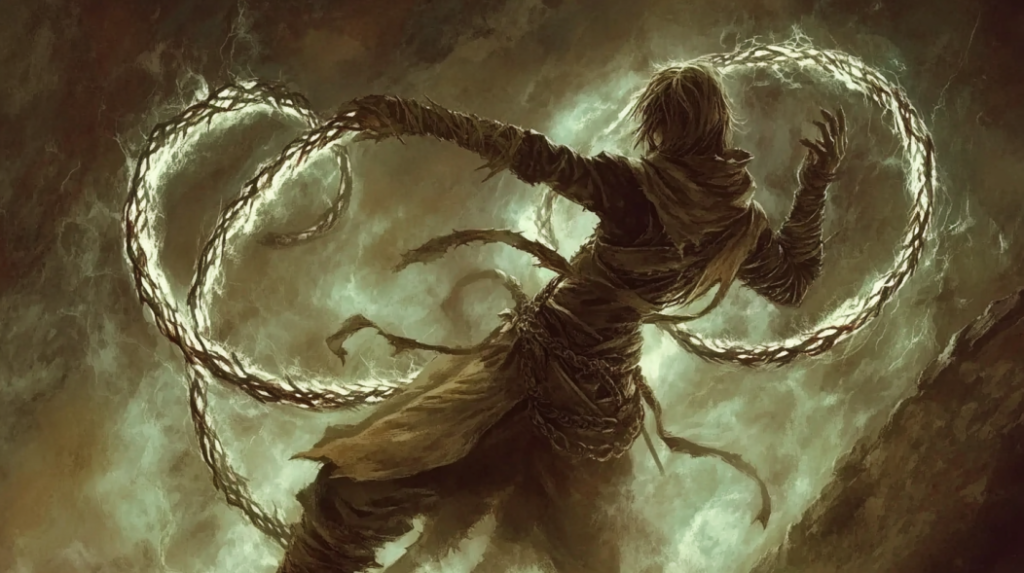
A manifestation of transmutation, Thorn Whip materializes as an arcane cantrip, weaving a lash of vine interlaced with razor-sharp thorns.
This organic scourge becomes your conduit, poised to strike at a designated target within the confines of its attack range.
Should your assault find purchase, the recipient suffers the bite of 1d6 piercing damage.
Moreover, should your chosen quarry assume the stature of Large or smaller, an added boon manifests – a compelling ability to draw them proximately by up to 10 feet, tugging them closer within your grasp.
Detailed specifics of this spell can be gleaned from the Player’s Handbook, conveniently indexed on page 282, accessible not only to adept Artificers but also to attuned practitioners of the Druidic tradition.
Amidst the intricate tapestry of battle, Thorn Whip serves as an emblematic representation of your adeptness.
Envision yourself as a conductor, orchestrating a symphony of natural forces to summon forth this living whip.
As your focus aligns with the incantation, you metamorphose into a thorn caster, wielding a conjured extension of a plant stem.
Each component harmoniously interlocks – the command of your will intertwined with the trajectory of the whip, converging in an exquisite melee spell attack that seeks out its designated adversary.
This spell unfurls as a testament to the seamless fusion of your prowess as a druid and the very essence of this captivating cantrip.
Upon the stage of engagement, the efficacy of Thorn Whip assumes manifold dimensions.
Your choices ripple through the intricacies of battle, guiding your actions and influencing your opponents’ movement.
Consider the nuanced escalation in damage potential, an escalation that surges in correlation to your escalating levels of mastery.
With each incremental advancement, the thorns embedded within the whip’s lash become an embodiment of your growth, augmenting the punishment inflicted upon contact.
To wit, envision a scenario where tactical insight shines – a fluid sequence where opportunity cascades.
As you wield the Thorn Whip with dexterity, the battlefield transforms into a terrain of strategic advantage.
Contemplate a situation where a foe, perhaps a creature of considerable proportions, stands vulnerable in proximity.
Herein lies an opening, a prospect to capitalize upon the spell’s ability to manipulate your adversary’s location.
A calculated flourish and your adversary is drawn within reach, bridging the spatial gap and entrapping them within the clutches of your artful maneuver.
Moreover, the conjured thorns are emblematic of the synergy between nature’s bounty and your mastery over spellcraft.
Each thorn, a representation of a druid’s communion with the primal forces, harkens to the essence of your connection with the very fabric of existence.
Through your agency, the undercurrents of magic surge, and the whip’s thorns flourish, extending their reach and unraveling the latent potential within.
The Thorn Whip, a conduit of both offense and tactical maneuvering, extends its influence even to the cadence of combat’s ebb and flow.
When embroiled in the kinetic dance of battle, the Thorn Whip becomes an instrument of opportunity. As adversaries converge and diverge, the allure of seizing a moment presents itself – the prospect of wielding your art with finesse and precision.
Seize the initiative, and the Thorn Whip becomes a vehicle to enact opportunity attacks, allowing you to exploit gaps in your adversaries’ defense deftly.
This stratagem adds an additional layer of depth to the battlefield dynamics, wherein you dictate the narrative of engagement.
In the annals of Dungeons & Dragons, where creativity melds with strategy, Thorn Whip emerges as a testament to the multifaceted nature of spellcasting.
A spell that transcends mere mechanics, it reverberates with the potential to ensnare both the imagination of players and the resolve of adversaries.
As you embrace this spell, envision yourself as the orchestrator of nature’s fury, wielding the whip with a mastery that commands not just its physical form but the very essence of the environment it springs from.
Through the Thorn Whip, you bridge the realms of possibility, an embodiment of both the art and science that define the arcane tapestry of Dungeons & Dragons.
Understanding the Thorn Whip 5e Spell
The Thorn Whip spell is an artificer’s dream, an intriguing and versatile link for spellcasters in Dungeons & Dragons 5th Edition.
Let’s delve into the intricate world of this magical thing to understand its power better in the terrain of combat scenarios.
Thorn Whip falls under the transmutation school of magic, allowing artificers to manipulate nature itself like skilled artisans.
When wielding this spell, an artificer conjures a vine-like whip covered in thorns, crafting a visual masterpiece that’s ready to strike enemies within its calculated range.
The visual imagery alone makes it an alluring choice, an artificer’s masterpiece, for those seeking an idea more closely tied to a nature-oriented approach to melee attacks.
The attack made with Thorn Whip is a melee spell attack, demonstrating an artificer’s finesse as it utilizes the caster’s spellcasting ability modifier and proficiency bonus.
This allows for seamless integration, the utility of artificer training, with other spellcasting abilities and tactics during the battle.
What makes Thorn Whip particularly fascinating is its additional utility when attacking smaller creatures or enemies who are large or smaller.
Upon successfully hitting the target with artificer precision, the caster can artfully pull them up to 10 feet closer, wielding terrain manipulation as if an artificer’s skilled hand is at play.
This feature not only inflicts damage upon impact but also grants a tactical advantage by artificer-like repositioning, adversaries strategically manipulated on the terrain of choice.
Imagine an intense encounter where you find your party separated in a dangerous artificer’s game from key allies or attempting to protect vulnerable members artfully.
In such an artificer’s strategic case, Thorn Whip could prove invaluable as you yank an enemy away from your friend, possibly disrupting their artificer-crafted attacks or creating space for a safer retreat.
It allows for creative problem-solving and improvisation on the artificer’s canvas of combat encounters.
The damage artfully inflicted by the Thorn Whip spell starts at 1d6 piercing damage, which artfully increases as the character levels up, progressing like an artificer’s journey.
At the 5th level, it artfully intensifies to 2d6; by the 11th level, it becomes even more artfully deadly at 3d6; and finally, at a formidable 17th level, it reaches its peak artificer-crafted damage potential of 4d6 piercing damage.
These scaling artificer effects mirror the growth of character power, the development of a finely tuned artificer’s masterpiece throughout their adventuring journey.
The Thorn Whip spell artfully combines offensive capabilities with tactical maneuvering, as if an artificer’s craftsmanship is at work, making it an excellent tool for artificers who enjoy versatility in battle, mastering the terrain with artificer-like precision, and want to control the flow of combat like true artificer artisans.
Now that we comprehend the various aspects of the Thorn Whip spell’s mechanics let’s explore its casting time and range to optimize our combat strategies even further.
Thorn Whip is a cantrip that falls under the Transmutation school of magic, which represents about 11% of all available spells in Dungeons and Dragons 5th Edition.
According to a published survey on player class preferences, approximately 12% of respondents preferred the Druid class, one of two classes capable of casting the Thorn Whip spell.
The chance of hitting a creature with the Thorn Whip spell requires a melee spell attack roll.
According to data, when rolling a d20 (the primary die for D&D), there’s an average probability of 50-55% to hit a typical creature’s Armor Class (AC), depending on the caster’s proficiency and ability modifiers.
Casting Time and Range
The casting time and range of a spell play a crucial role in shaping its advantage and usefulness in various situations.
When examining Thorn Whip, these key factors seamlessly integrate into your tactical approach on the battlefield.

Thorn Whip’s spell-casting demands only 1 action, allowing you to harness its power when your turn arrives in combat swiftly.
This prompt execution opens windows for diverse actions or maneuvers, enriching your combat choices.
The nimbleness of spells like Thorn Whip proves invaluable, enabling adaptable responses amidst the fluidity of battle.
Delving into its range, Thorn Whip offers an impressive span of 30 feet.
This considerable reach establishes a substantial gap between you and your intended target, a tactical boon that facilitates long-distance engagement.
Your strategic stance gains depth as you grasp the option to aid besieged comrades or strike at evasive adversaries positioned beyond the melee frontier.
Imagine a scenario in which your party confronts aerial assailants or foes armed with extended weapons.
Here, Thorn Whip emerges as the equalizer, extending your influence across the battleground while sidestepping potential hazards and obstructions.
With its swift casting and expansive range, Thorn Whip emerges as a dual-purpose tool for players, augmenting both their offensive prowess and their strategic positioning throughout the ebb and flow of combat scenarios.
This enhances its significance as an invaluable asset within your arsenal.
Utilizing Thorn Whip in Combat
When delving into the realm of combat mastery, the connection between versatility and power becomes apparent, and this holds true for the world of Dungeons & Dragons.
The Thorn Whip spell, an artificer of arcane mechanics and natural elements, exemplifies the fusion of these aspects seamlessly.

This arcane link presents a choice, a strategic idea that resonates with those who seek utility in both ranged and melee engagements.
In the case of Thorn Whip, the artificer’s craft merges with the primal forces of nature, creating a potent conduit. Imagine a terrain of intricate possibilities—a dense forest, an open battlefield, or a treacherous dungeon.
In each case, the Thorn Whip manifests as a versatile tool, a bridge between the tangible and the arcane.
Within the intricate dance of combat, positioning emerges as the linchpin of tactical advantage. The 30-foot reach of Thorn Whip constructs a sphere of influence, a zone of potential control.
With this power at hand, one can engage foes from a safer distance, granting a realm of choice in the chaos of battle.
This is a crucial factor, especially for those who embrace the artificer class’s knack for measured strikes over direct, unyielding melee attacks.
Picture a scenario where a war caster artificer, having meticulously attuned their skills, stands as a sentinel at the edge of the fray.
Armed with the capability to wield Thorn Whip as an opportunity attack, they seize the chance to halt an adversary’s hasty retreat.
In this melee attack, the artificer channels the very essence of their craft through the whip, infusing it with shillelagh-like potency, a marriage of magic and material.
A bit of arcane distance can shift the tides of confrontation.
This becomes evident as the whip’s grasp extends, allowing the artificer to ensnare a foe attempting to flee the melee.
Elements align—a question of timing, a choice of strategy. The artificer seizes the opportunity, employing Thorn Whip’s power to thwart the foe’s escape and draw them back into the heart of the conflict.
Beyond the mechanics lies a symbiotic dance between class and terrain.
Artificers, with their meticulous minds, flourish amidst the intricate tools of combat.
This terrain, whether physical or magical, becomes the canvas upon which the artificer paints their tactical masterpiece.
It is in these moments that the artificer’s utility truly shines—an inventive twist that elevates the spell beyond mere combat prowess.
In this intricate ballet of mechanics and imagination, Thorn Whip offers not just a tool of conflict, but a catalyst of choice, a key to unlocking unorthodox solutions.
Imagine a battlefield where cantrips are not mere flares of magic but decisive strokes of strategy.
The artificer, embracing their role, combines the finesse of a master tactician with the power of a spellcaster.
As the dust settles on each encounter, the resounding echoes of Thorn Whip’s influence linger.
An ally’s escape was cut short, and an opponent’s momentum halted—a symphony of battlefield control.
In this convergence of opportunity and preparedness, the spell transcends its simple function and emerges as an embodiment of the artificer’s ingenuity.
So, whether you find yourself on the front line or at a distance, remember the whispering promise of Thorn Whip.
With its power, you command the ebb and flow of battle, shaping the very terrain upon which destinies are woven.
In this melding of artifice and the arcane, Thorn Whip beckons you to wield its potential, to become an architect of advantage in the vibrant tapestry of Dungeons & Dragons combat.
Commanding the Vine-Like Whip
As a spellcaster wielding the power of Thorn Whip, it’s important to understand how you can command and control this formidable weapon.
While its description is sparse, it leaves room for creative interpretation and strategic thinking.

Think of commanding the vine-like whip as an extension of your will and intent. You can visually imagine yourself guiding it through precise gestures or mentally directing its movements.
This mental connection allows you to manipulate the whip’s trajectory and target selection based on your tactical needs during combat.
You envision the vine-like whip extending from your outstretched hand as if it were a part of your own arm.
With a flick of your wrist, it curls around an enemy’s leg, tightening its grip before jerking them off its feet.
The versatility of commanding the vine-like whip opens up opportunities for creative strategies in combat encounters.
For instance, you could focus your attacks on specific targets vulnerable to piercing damage while keeping more formidable opponents at bay.
This level of control enables you to adapt your strategy according to the composition of enemies faced.
Picture this: You find yourself battling a hulking ogre alongside a swarm of lesser minions. Rather than engaging in direct confrontation with the ogre, you deftly maneuver your vine-like whip toward its legs, causing it to buckle under its own weight.
This temporary immobilization allows you and your allies to focus your attacks on the smaller, more manageable enemies before turning your attention back to the ogre.
Now that we have explored the utilization and commanding aspects of Thorn Whip in combat scenarios, you have a solid foundation for mastering this versatile spell.
However, there’s still more to uncover about Thorn Whip – its damage calculation.
Damage Calculation of Thorn Whip Spell
The Thorn Whip spell in Dungeons & Dragons 5e is a powerful transmutation cantrip that allows spellcasters to summon a vine-like whip covered in thorns.
This spell not only provides a means of attack but also has damage potential that scales with the caster’s level.

Understanding how the damage is calculated is crucial for maximizing its effectiveness on the battlefield.
When casting Thorn Whip, the player must perform a melee spell attack against their target. If the attack hits, it inflicts piercing damage.
The base damage for Thorn Whip is 1d6 at all levels. But what sets this spell apart is its ability to pull creatures closer if they are Large or smaller in size.
Imagine an elven druid named Elysia who is facing off against a fearsome ogre.
Seeing the opportunity to strike, she casts Thorn Whip and makes her melee spell attack roll, successfully hitting the ogre. The spell deals 1d6 piercing damage to the creature.
Piercing Damage and Level Scaling
As characters in D&D 5e progress and gain more experience, their abilities become stronger. The same goes for the Thorn Whip spell.
Its base damage of 1d6 increases as the caster reaches higher levels, allowing them to deal significant amounts of damage over time.
At the 5th level, the damage increases to 2d6, and at the 11th level, it becomes 3d6. Finally, at the 17th level, the caster can unleash a devastating Thorn Whip that deals 4d6 piercing damage upon a successful hit.
This scaling effectively reflects the growing power and mastery of the character using this spell.
It’s worth noting that leveling up not only enhances the range of options available to players but also provides opportunities to deal more substantial amounts of damage, making them even more formidable on the battlefield.
Understanding how the Thorn Whip damage is calculated, and its scaling with character levels allows players to make informed decisions during combat. But what advantages does targeting Large or smaller creatures provide? Let’s explore this aspect in the next section.
Advantages of Large or Smaller Target
When casting the Thorn Whip spell, one of its distinct advantages lies in its ability to target creatures that are Large or smaller.
Let’s explore why this distinction is significant and how it can benefit players in combat.
When a creature is classified as Large or smaller, it refers to the creature’s size category. Creatures of size medium or smaller fall into this category, while creatures like giants or large creatures are considered Large.
It’s important to note that the size category primarily affects the mechanics of certain spells and abilities, including the Thorn Whip spell.
Here’s a scenario where understanding this advantage becomes crucial: Imagine facing off against a hulking ogre threatening your party.
The Thorn Whip spell allows you to make a melee spell attack against this Large creature. If your roll is successful, not only will the ogre take piercing damage, but you’ll also have the ability to pull it closer to you by up to 10 feet.
This advantage can be instrumental in several ways.
Firstly, pulling an enemy toward you helps mitigate their movement options, preventing them from closing the gap between themselves and other party members.
This can protect squishier characters who may struggle in close-quarters combat.
In addition, dragging enemies closer can provide tactical advantages for both ranged and melee attackers.
Ranged characters will find it easier to consistently hit their targets as they won’t need to worry about constantly readjusting their range.
Melee characters, on the other hand, can use this mechanic to maintain control over their opponents and keep them within striking distance.
Additionally, consider the benefits of combining the Thorn Whip spell with teamwork. For example, if your ally is a caster with area-of-effect spells like Fireball or Thunderwave, pulling enemies closer might group them together nicely and maximize the effectiveness of these spells.
Ultimately, mastering the advantage of targeting Large or smaller creatures with the Thorn Whip spell can significantly influence the flow of combat, create strategic opportunities, and give your party an upper hand.
Now that we’ve explored the advantages of the Large or smaller target distinction, let’s delve into another crucial aspect of the Thorn Whip spell: the pulling mechanic.
The Pulling Mechanic
The Thorn Whip spell’s unique ability to pull a target closer adds an extra layer of versatility to its combat applications.
Being able to manipulate the positioning of enemies can be a game-changer in various scenarios.
Imagine you’re facing a slippery rogue who prides themselves on their agility and ability to dart in and out of combat.
They’ve been consistently avoiding your attacks and frustrating your party.
In this situation, the Thorn Whip spell provides a valuable tool for reeling them in, preventing them from escaping or frustratingly flanking your allies.
By successfully hitting the target with your melee spell attack, you can immediately pull them up to 10 feet closer to you.
This ensures that even if they try to retreat or maneuver around the battlefield, they cannot easily escape your reach. This mechanic is particularly useful against mobile or hit-and-run opponents who rely on their speed and evasiveness.
Moreover, the pulling mechanic complements other spells or abilities that benefit from close proximity.
For example, imagine combining Thorn Whip 5e spell with a spell-like Hold Person.
Once you’ve successfully pulled an enemy within range, it becomes easier for allies to lock them down with controlling spells or unleash devastating melee attacks.
Think of it as reeling in a fish on a line – once you’ve made contact and successfully hooked them with your Thorn Whip, you have control over their movement, bringing them closer to you and potentially neutralizing their advantages.
The Thorn Whip spell’s ability to pull enemies closer provides a valuable tool for controlling the battlefield, particularly against mobile or evasive opponents.
This mechanic also complements other spells or abilities that benefit from close proximity, making it a versatile option for combat situations.
Think of it like reeling in a fish – once you hook them with the Thorn Whip, you have control over their movement and can potentially neutralize their advantages.
Thorn Whip in Various Classes
The versatility and power of the Thorn Whip spell make it a favorite among many classes in Dungeons & Dragons 5e.
Let’s explore how different classes can harness the potential of this transmutation cantrip.
Druid: As masters of nature, druids naturally excel with the Thorn Whip spell. By tapping into their connection to the natural world, druids can summon forth thorny vines to strike at their enemies.
The Thorn Whip complements the druid’s arsenal of spells and abilities, allowing them to keep enemies at bay or pull them closer for melee attacks.
For example, a druid might cast the Thorn Whip to yank an enemy out of reach and prevent them from fleeing, giving their comrades an opportunity to strike.
Ranger: Rangers are skilled trackers and hunters, and the Thorn Whip spell supports their tactical precision. With their focus on both melee combat and ranged attacks, rangers can use Thorn Whip to create opportunities in battle.
They might use it to pull an enemy archer closer, disrupting their aim and forcing them into close-quarters combat where the ranger excels. Alternatively, a ranger could use Thorn Whip to reach distant foes who are trying to keep their distance.
Artificer: Artificers are masters of magical inventions and creations. While they may not have innate magical abilities like other spellcasting classes, they compensate for it with meticulous craftsmanship. Artificers can infuse objects with magic, including thorny whips that mimic the effects of the Thorn Whip spell.
These mechanically inclined adventurers can augment their combat prowess by crafting customized tools that incorporate the Thorn Whip’s unique abilities.
Bard: Bards are known for their versatility and charm. While not traditionally associated with offensive spells, they can still utilize Thorn Whip creatively in combat situations. Bards may employ it as a distraction, causing enemies to focus on the swirling thorny vine instead of the bard’s allies.
They can also use Thorn Whip as a disengage tool, allowing them to pull themselves or an ally out of a dangerous situation.
The Thorn Whip spell opens up exciting possibilities for various classes, enhancing their combat strategies in unique ways.
However, let’s now shift our focus to the specific applications of Thorn Whip within the Artificer and Druid classes.
Artificer and Druid Class Applications
Artificers are known for their ability to tinker with magical devices and create wonders. By combining their expertise in crafting with the versatility of Thorn Whip, artificers can create potent tools for combat.
They might invent a glove infused with arcane energy that allows them to generate thorny vines at will.

This adaptation of Thorn Whip enables artificers to engage in both short-range and long-range combat, giving them an edge in various scenarios. Additionally, artificers could create enchanted whips that have additional effects when using Thorn Whip, such as inflicting poison damage or restraining enemies upon a successful hit.
On the other hand, Druids are intimately attuned to nature’s forces.
With their connection to plants and animals, druids seamlessly integrate Thorn Whip into their spell repertoire.
When casting the spell as a druid, they summon forth thorny tendrils from nearby plant life to ensnare and strike their foes.
The mobility granted by Thorn Whip allows druids to maintain distance or bring enemies closer. For druids focused on melee combat, Thorn Whip becomes a reliable tool for closing gaps quickly and effectively.
Whether as an ingeniously crafted invention or harnessed through communion with nature, Thorn Whip offers distinct benefits within the Artificer and Druid classes.
Is there a range limit to how far away a target can be for the Thorn Whip spell to work effectively in D&D 5e?
Yes, there is a range limit for the Thorn Whip spell in D&D 5e.
According to the official Player’s Handbook, the range of the spell is 30 feet. This means that the target must be within 30 feet of the caster for the spell to work effectively. Beyond that distance, the whip would not be able to reach the target and have any effect.
What classes can learn the Thorn Whip spell in D&D 5e?
In D&D 5e, the Thorn Whip spell can be learned by several classes, such as Druids and Warlocks. Druids have access to a wide range of nature-themed spells, including Thorn Whip, which aligns with their connection to the natural world.
Warlocks, on the other hand, gain access to this spell through their Pact of the Blade feature, allowing them to summon a magical whip imbued with thorny vines.
Both classes offer unique playstyles and opportunities for creative combat strategies utilizing the Thorn Whip spell.
How much damage does the Thorn Whip spell deal in D&D 5e?
The Thorn Whip spell in D&D 5e deals 1d6 piercing damage. However, if the spell is cast using a higher level spell slot, it deals an additional 1d6 damage for each level above 1st. This makes it a versatile and effective spell for dealing damage at various levels of play.
What level do you have to be to cast the Thorn Whip spell in D&D 5e?
In D&D 5e, the Thorn Whip spell can be cast starting at the 1st level. This is supported by the official Player’s Handbook, which lists the spell as a 0-level cantrip for druids. Cantrips are spells that can be cast an unlimited number of times without expending spell slots, making them accessible from the earliest levels of play.
Does the Thorn Whip spell have any additional effects or conditions attached?
Yes, the Thorn Whip 5e spell has an additional effect. If the spell successfully hits a target, it not only deals damage with a thorny whip but also pulls the target closer to the caster.
This can be advantageous for tactical positioning or setting up attacks from other party members. The spell’s range is 30 feet, and the target is pulled up to 10 feet closer to the caster upon a successful hit.